Ontario smoke and CO alarm requirements help ensure homes have appropriate warning devices for both fire and carbon monoxide hazards. Smoke and carbon monoxide alarms serve different purposes, have different placement requirements, and both need to be installed and maintained correctly.
Ontario also expanded its carbon monoxide (CO) alarm requirements effective January 1, 2026. For homes that are subject to the CO alarm requirements, alarms are now required on every storey, including storeys without sleeping areas. Ontario
Whether you own a house, manage a rental property, or are simply reviewing your home’s safety equipment, understanding the current requirements can help you identify missing, outdated, or improperly located alarms.
Important: This guide provides general information about Ontario requirements. Requirements can vary depending on the age, construction, occupancy and configuration of a building. For requirements specific to your property, consult your local fire department or other authority having jurisdiction.
What Are the Smoke Alarm Requirements in Ontario?
Every home in Ontario must have working smoke alarms on every storey and outside all sleeping areas. Homeowners are responsible for installing and maintaining the required smoke alarms in their homes. Ontario
For a typical multi-level house, this means you should not think only about the bedroom floor. A basement, main floor and upper floor all need appropriate smoke-alarm coverage.
Ontario’s Fire Code requires smoke alarms:
- in the hallway when a sleeping area is served by a hallway;
- between the sleeping area and the remainder of the dwelling when there is no hallway;
- on each storey that does not contain a sleeping area; and
- in certain sleeping rooms that are not within a dwelling unit. Ontario
Different requirements can apply to particular building types or newer construction, so homeowners should avoid assuming that the minimum layout for one house automatically applies to another.
Does Every Floor of an Ontario Home Need a Smoke Alarm?
Yes. Ontario requires a working smoke alarm on every storey of a home, as well as outside sleeping areas. Ontario
For example, if your home has a basement, main floor and second floor, smoke-alarm coverage is required throughout the home — not just near the upstairs bedrooms.
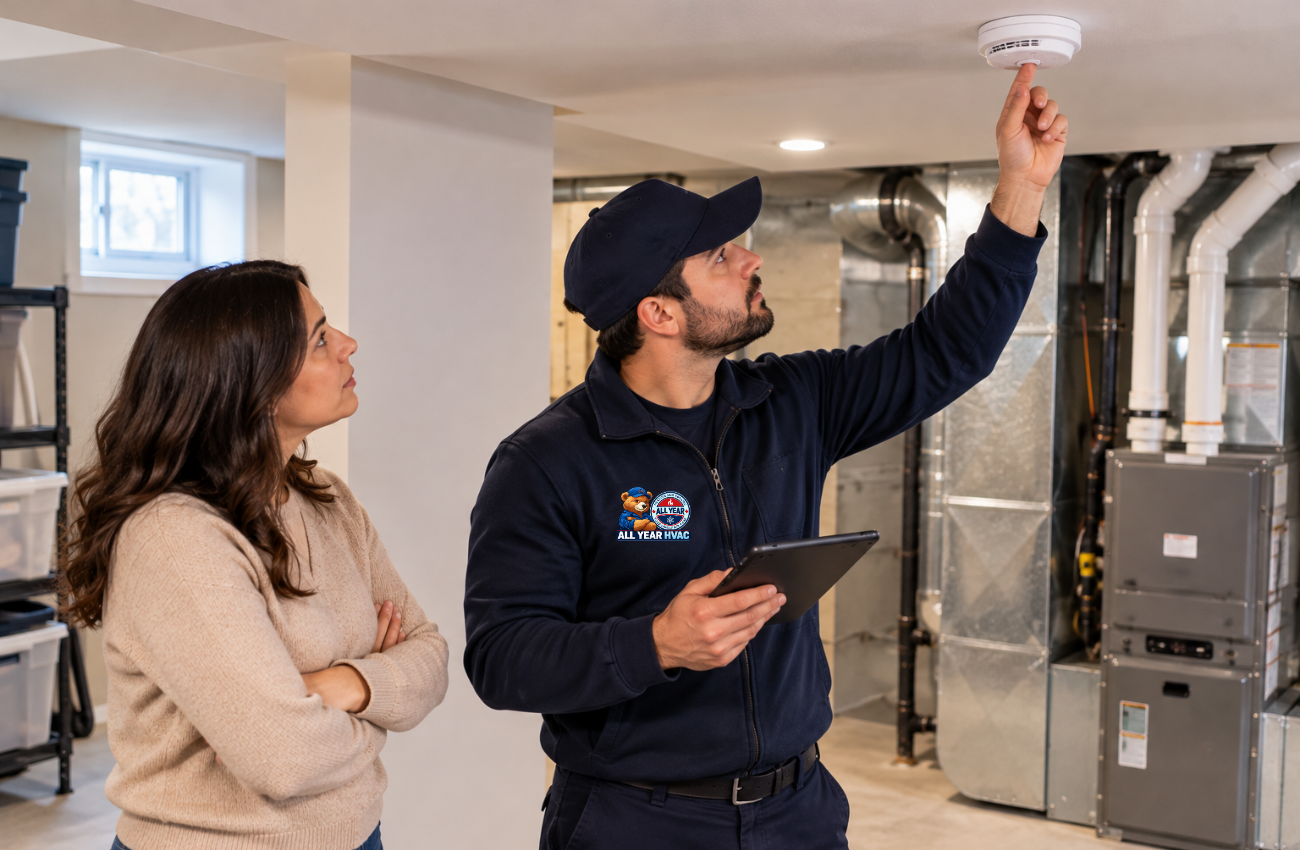
Smoke alarms should generally be installed on or near the ceiling and positioned according to the manufacturer’s instructions. Ontario advises avoiding locations too close to bathrooms, windows, ceiling fans, and heating or cooking appliances. Ontario
How Often Should You Test and Replace Smoke Alarms?
Ontario recommends testing smoke alarms every month using the test button. If an alarm does not sound, check the battery where applicable; if it still does not operate, the alarm should be replaced. Ontario
Batteries should be changed at least annually or according to the manufacturer’s instructions, and whenever the low-battery warning sounds.
Smoke alarms do not last indefinitely. Ontario advises replacing smoke alarms every 10 years according to the manufacturer’s instructions. Always check the manufacturer’s replacement date or instructions for the specific device installed in your home. Ontario
What Are the Carbon Monoxide Alarm Requirements in Ontario?
Carbon monoxide is different from smoke. It is an invisible, odourless gas that can be produced when fuels such as natural gas, propane, oil or wood do not burn completely.
Ontario’s CO alarm requirements apply to homes in circumstances that include having:
- a fuel-burning appliance;
- a fireplace;
- an attached garage; or
- heated air supplied by a fuel-burning appliance located outside the home, a provision that took effect January 1, 2026. Ontario
For many Ontario homes, a natural-gas furnace or water heater means CO alarm requirements are particularly important.
What Changed for Carbon Monoxide Alarms in Ontario in 2026?
One of the most important home-safety changes for Ontario homeowners took effect on January 1, 2026.
For homes subject to the CO alarm requirements, carbon monoxide alarms are now required:
- adjacent to each sleeping area; and
- on every storey, including storeys without sleeping areas. Ontario
Previously, many homeowners primarily associated CO alarms with areas near bedrooms. The 2026 requirements expand coverage throughout affected homes.
For example, if you have a three-level house with bedrooms upstairs and a natural-gas furnace in the basement, you should not assume that a single CO alarm outside the bedrooms provides all the coverage required under the current rules.
Read Ontario’s current carbon monoxide alarm requirements
Does Every Floor Need a Carbon Monoxide Alarm in Ontario?
For homes that fall under Ontario’s CO alarm requirements, yes. As of January 1, 2026, CO alarms are required on every storey, including storeys without sleeping areas, as well as adjacent to each sleeping area. Ontario
This is an important distinction because not every home has the same layout.
A basement containing a gas furnace, a main living level and an upstairs bedroom level should all be considered when reviewing CO alarm coverage.
The exact installation location of an alarm should follow the manufacturer’s instructions. Ontario permits qualifying CO alarms that are hardwired, battery-operated or plug-in devices. Combination smoke/CO alarms are also available. Ontario
Where Should CO Alarms Be Installed in a Home With a Gas Furnace?
If a fuel-burning appliance such as a gas furnace is located within the residential occupancy, Ontario’s Fire Code requires CO alarms adjacent to each sleeping area and on each storey without a sleeping area. Ontario
However, homeowners should not simply install a CO alarm directly beside the furnace unless that location is appropriate under the applicable requirements and the alarm manufacturer’s instructions.
The purpose is to provide the required coverage throughout the home. Always follow the installation instructions supplied with the alarm.
What If Your Home Has an Attached Garage?
An attached garage is another important reason to review your home’s CO alarm coverage.
Ontario identifies homes with an attached garage among those requiring CO alarms. The Fire Code also contains specific requirements where residential spaces share a wall or floor/ceiling assembly with a storage garage. Ontario
Even if your home does not have a gas furnace, an attached garage can therefore make CO alarms necessary.
What If a Furnace Serves Multiple Apartments or Units?
The requirements become more specific when a fuel-burning appliance is located outside an individual residential suite.
For example, if a furnace is located in a building service room and serves multiple residential units, Ontario’s Fire Code includes requirements for the service area and for certain residential suites that share a wall or floor/ceiling assembly with that area. The updated rules also address public corridors directly heated by a forced-air fuel-burning appliance. Ontario
Owners of duplexes, multi-unit properties and buildings with shared heating systems should therefore avoid applying a standard single-family-home alarm layout without checking the requirements for their particular building.
Smoke Alarm vs. Carbon Monoxide Alarm: What’s the Difference?
Smoke alarms and CO alarms protect against different hazards.
A smoke alarm detects products associated with a fire and provides occupants with an early warning so they can leave the home.
A carbon monoxide alarm detects dangerous concentrations of CO, which may be produced by fuel-burning equipment, fireplaces, vehicles and other combustion sources.
Having one does not eliminate the need for the other when both are required.
Combination smoke and CO alarms can provide both functions in one approved device, but the device still needs to be installed in a location that satisfies the applicable requirements and manufacturer’s instructions. Ontario
Can a Carbon Monoxide Alarm Tell You Whether Your Furnace Is Safe?
No. A CO alarm is an important warning device, but it is not a substitute for inspecting and maintaining fuel-burning equipment.
Pressing the test button confirms that the alarm’s test function operates. It does not inspect your furnace’s heat exchanger, burners, venting, gas pressure or combustion.
A furnace can develop problems that require professional attention before a household CO alarm activates.
Regular heating-system maintenance can help identify operating concerns and keep the equipment working as intended. Learn more in our guide to annual furnace maintenance.
If your furnace is older and you are beginning to experience repeated problems, you can also review how long furnaces typically last in Ontario.
What Should You Do If a Carbon Monoxide Alarm Sounds?
Treat a CO alarm seriously. Do not assume it is simply a malfunctioning detector.
Ontario advises occupants to move outside to fresh air immediately and call 911, the fire department or emergency services. Do not try to locate the source of carbon monoxide yourself. Ontario
Once emergency responders determine that it is safe to proceed, the fuel-burning equipment may need to be inspected by an appropriately qualified technician before it is returned to normal operation.
What Are the Smoke and CO Alarm Responsibilities for Ontario Landlords?
Rental properties have an additional layer of responsibility.
For smoke alarms, the landlord is responsible for ensuring the rental property complies with Ontario’s requirements. Tenants must not remove batteries or tamper with required alarms. Ontario
For carbon monoxide alarms, Ontario similarly identifies the landlord as responsible for Fire Code compliance in rental homes. Ontario
Landlords should therefore have a reliable process for checking alarm locations, testing required devices, tracking replacement dates and addressing reported problems.
Tenants should notify their landlord promptly if an alarm is not operating properly or appears to be impaired.
What Should Waterloo Rental Property Owners Know?
Waterloo landlords should consider smoke and CO alarm compliance as one part of a broader rental-property safety and licensing process.
The City of Waterloo introduced updated rental licensing requirements effective July 1, 2026. Among the documentation requirements for applicable rental licence applications is a Gas or Oil Heating Appliance Inspection — Form E, completed by a licensed gas fitter, or a declaration where there are no applicable gas or oil-fuelled appliances. City of Waterloo
It is important not to confuse these requirements.
A gas-appliance inspection and smoke/CO alarm compliance are not the same thing. Testing an alarm does not establish that a furnace is operating safely, and inspecting a furnace does not eliminate the property’s alarm requirements.
Waterloo landlords can learn more in our guide:
Rental Property Gas Appliance Inspections in Waterloo: What Landlords Need to Know
The City states that Form E must be completed by a licensed gas fitter and, for the applicable applications and renewals, must be dated within the previous 12 months. City of Waterloo
City of Waterloo rental licensing requirements
Why Furnace Safety and CO Safety Go Together
A properly installed CO alarm provides an essential warning if carbon monoxide reaches a dangerous level, but prevention also matters.
Fuel-burning equipment should operate with proper combustion and venting. Problems involving a furnace, water heater, fireplace or venting system can create safety concerns that should be assessed by qualified professionals.
If your furnace is behaving unusually — for example, failing to heat properly or repeatedly shutting down — avoid ignoring the problem simply because your CO alarm has not activated.
Our guide to common furnace heating problems explains several signs that may warrant professional furnace service.
For homeowners considering whether an aging furnace is still worth repairing, see our furnace repair vs. replacement guide.
A Simple Smoke and CO Alarm Checklist for Ontario Homeowners
Use this general checklist as a starting point:
- Confirm that you have working smoke alarms on every storey and outside sleeping areas.
- Test smoke alarms monthly.
- Check the manufacturer’s replacement date on each smoke alarm.
- Determine whether your home is subject to Ontario’s CO alarm requirements because of a fuel-burning appliance, fireplace, attached garage or applicable forced-air heating arrangement.
- If CO requirements apply, confirm coverage adjacent to sleeping areas and on every storey under the 2026 requirements.
- Follow the manufacturer’s instructions for alarm placement and maintenance.
- Never disable an alarm because of nuisance alarms or repeated activation.
- Make sure everyone in the home knows what to do if a smoke or CO alarm sounds.
- Remember that an alarm does not replace proper maintenance of your furnace and other fuel-burning equipment.
Frequently Asked Questions About Smoke and CO Alarms in Ontario
Are smoke alarms required on every floor in Ontario?
Yes. Ontario requires working smoke alarms on every storey of a home and outside sleeping areas. Ontario
Are carbon monoxide alarms required on every floor in Ontario?
For homes subject to Ontario’s CO alarm requirements, CO alarms are required on every storey, including storeys without sleeping areas, effective January 1, 2026, as well as adjacent to each sleeping area. Ontario
Does a house with a gas furnace need carbon monoxide alarms?
A fuel-burning appliance such as a natural-gas furnace is one of the conditions that triggers Ontario’s residential CO alarm requirements. Ontario
Does a home with an attached garage need a CO alarm?
Yes, an attached garage is one of the conditions identified by Ontario for residential CO alarm requirements. Ontario
Can I use a combination smoke and carbon monoxide alarm?
Yes. Combination devices are available, provided they meet the applicable standards and are installed in locations that satisfy the relevant requirements. Always follow the manufacturer’s instructions. Ontario
How often should I test my smoke alarms?
Ontario recommends testing smoke alarms monthly using the test button. Ontario
How often should smoke alarms be replaced?
Ontario advises replacing smoke alarms every 10 years according to the manufacturer’s instructions. Check the specific replacement information for your alarm. Ontario
Who is responsible for alarms in an Ontario rental property?
The landlord is responsible for ensuring required smoke and CO alarms comply with Ontario requirements in rental properties. Ontario
Is a CO alarm a substitute for furnace maintenance?
No. A CO alarm warns occupants when it detects carbon monoxide at specified levels; it does not inspect the furnace or verify that the heating system is operating correctly.
Protect Your Home Beyond the Alarm
Smoke and carbon monoxide alarms are essential safety devices, but they are only one part of maintaining a safe home.
If you have concerns about your gas furnace, unusual operation, venting, or the condition of your heating equipment, All Year Heating & Cooling Inc. provides professional residential HVAC and gas services throughout Kitchener, Waterloo, Cambridge, Guelph and surrounding communities.
You can contact All Year Heating & Cooling to arrange service or ask about your home’s heating equipment.
For official requirements and property-specific questions about smoke or carbon monoxide alarms, homeowners and landlords should consult the appropriate fire department or authority having jurisdiction.