If your furnace is getting older, you may be wondering how many more winters it can reliably heat your home. Furnace lifespan in Ontario is not determined by age alone. Installation quality, maintenance, operating conditions, airflow and repair history can all affect how long a furnace remains reliable.
Many residential gas furnaces can provide approximately 15 to 20 years of service, and some continue operating longer when properly installed and maintained. However, reaching a certain age does not automatically mean a furnace needs to be replaced.
The more useful question is whether an older furnace is still safe, reliable and practical to keep operating.
What Is the Average Furnace Lifespan in Ontario?
There is no exact expiration date for a furnace.
As a general guideline, residential gas furnaces commonly have a lifespan of around 15 to 20 years. Actual service life can vary depending on maintenance, usage, installation and operating conditions.
Ontario winters can require a furnace to operate for long periods during the heating season. How frequently the equipment runs, how well it was originally installed, whether it is properly sized and how consistently it has been maintained can all influence its condition over time.
A 17-year-old furnace that has been properly maintained and remains reliable may be in a very different condition from another furnace of the same age that has experienced airflow problems, repeated breakdowns or poor maintenance.
That is why furnace age should be treated as one factor rather than an automatic replacement rule.
What Can Affect the Lifespan of a Furnace?
Furnace lifespan in Ontario can vary from one home to another, even when similar equipment is installed.
Several factors can affect furnace longevity, including:
- Installation quality
- Proper furnace sizing
- Regular professional maintenance
- Furnace filter replacement and airflow
- How frequently the furnace operates
- Thermostat settings
- Condition of the ductwork
- Previous repairs and component failures
- Overall equipment quality and condition
Regular maintenance and proper airflow can help reduce unnecessary stress on furnace components.
7 Signs an Older Furnace May Be Approaching Replacement
Age by itself does not determine when a furnace should be replaced. However, when an older furnace begins showing several of the following signs together, it may be worth evaluating whether continued repairs still make sense.
1. Furnace Repairs Are Becoming More Frequent
One repair does not necessarily mean a furnace is near the end of its useful life.
The situation changes when service calls begin happening repeatedly. If different components are failing over a relatively short period, the overall condition of the furnace deserves a closer look.
Instead of considering only the cost of today’s repair, consider how much has already been spent and whether additional repairs are becoming increasingly likely.
2. The Furnace Needs a Major or Expensive Repair
A repairable furnace does not automatically need replacement.
However, the economics can change when an older furnace requires a significant repair. The age and condition of the furnace, previous repair history and expected cost of additional repairs should all be considered alongside the cost of replacement.
If you are facing this decision, our guide to furnace repair vs replacement explains the factors worth comparing before choosing either option.
3. Your Furnace Has Become Less Reliable
Reliability becomes especially important during an Ontario winter.
A furnace that occasionally requires a minor repair is different from one that repeatedly stops heating, fails to start or requires service to remain operational.
If you are increasingly concerned about whether the furnace will make it through another winter, reliability should become part of the replacement discussion.
4. Your Home Is No Longer Heating Comfortably
An aging furnace may still operate while the home becomes less comfortable.
You may notice:
- Rooms that are consistently colder than others
- Longer heating cycles
- Difficulty maintaining the thermostat setting
- Weak airflow from some registers
- Less consistent heating than in previous years
These symptoms do not automatically mean the furnace needs replacement. Filters, ductwork, controls, airflow and other system problems can also affect comfort.
A proper diagnosis should identify the cause before assuming the furnace itself has reached the end of its life.
5. The Furnace Is Making New or Unusual Noises
Furnaces make normal operating sounds, but new or increasingly noticeable noises deserve attention.
Rattling, banging, grinding, squealing or other unfamiliar sounds can sometimes indicate a component problem that requires service.
The noise itself does not determine whether the furnace should be replaced. What matters is what is causing the noise, the condition of the furnace and the cost of correcting the problem.
If your system has started sounding different, our guide to furnace making strange noises explains what some common furnace sounds may indicate.
6. Heating Costs Have Increased Without an Obvious Explanation
Higher heating bills do not automatically mean your furnace is failing.
Weather, thermostat settings, natural gas prices, insulation, air leakage and changes in household heating habits can all affect energy consumption.
However, if an older furnace appears to be running longer or more frequently while comfort has declined, it may be worth having the system evaluated.
Efficiency should be considered together with equipment condition and repair history rather than used as the only reason to replace a furnace.
7. There Are Safety or Combustion Concerns
Safety concerns require a different approach from ordinary comfort or efficiency issues.
Problems involving combustion, venting, gas supply, carbon monoxide or a suspected heat exchanger issue should be properly assessed by a qualified technician.
The presence of a safety concern does not automatically tell you whether repair or replacement is the correct solution. The specific problem, condition of the furnace and available corrective options need to be evaluated.
Homes with fuel-burning appliances should also have properly located and functioning carbon monoxide alarms.
Can a Furnace Last Longer Than 20 Years?
Furnace lifespan in Ontario varies, and some well-maintained systems may continue operating beyond 20 years.
However, operating and being worth keeping are not necessarily the same thing.
A furnace may still run at 20 or even 25 years old while requiring increasingly expensive repairs or becoming less reliable. Another older furnace may remain dependable with relatively minor service needs.
The decision should therefore be based on the individual furnace rather than age alone.
Should You Replace a Furnace Before It Completely Fails?
Not necessarily.
If an older furnace is operating safely and reliably and does not require significant repairs, immediate replacement may not be necessary.
There can still be an advantage to planning ahead. Waiting until a complete breakdown during very cold weather can turn a planned replacement into an emergency decision.
If your furnace is approaching the typical lifespan range, learning about replacement options and expected costs ahead of time can give you more time to make an informed decision.
Our guide to furnace replacement cost in Kitchener-Waterloo explains some of the major factors that affect the price of a new furnace and its installation.
Does Annual Maintenance Help a Furnace Last Longer?
Regular maintenance can help identify developing problems and keep the furnace operating properly.
Professional maintenance may include checking operating conditions, safety controls, combustion-related components, airflow and other parts of the heating system. Regular filter replacement is also important because restricted airflow can place additional stress on the equipment.
You can learn more in our guide to annual furnace maintenance and what a professional furnace tune-up can help identify.
What Should You Do If Your Furnace Is 15 to 20 Years Old?
You do not need to replace a furnace simply because it has reached a particular birthday.
Instead, this is a reasonable time to pay closer attention to:
- Repair frequency
- Reliability
- Safety
- Heating performance
- Overall equipment condition
- Recent repair expenses
- Potential upcoming repairs
Furnace lifespan in Ontario can extend beyond 20 years, but the decision to keep or replace an older system should be based on its individual condition rather than age alone.
Have an Older Furnace? We Can Help You Evaluate It
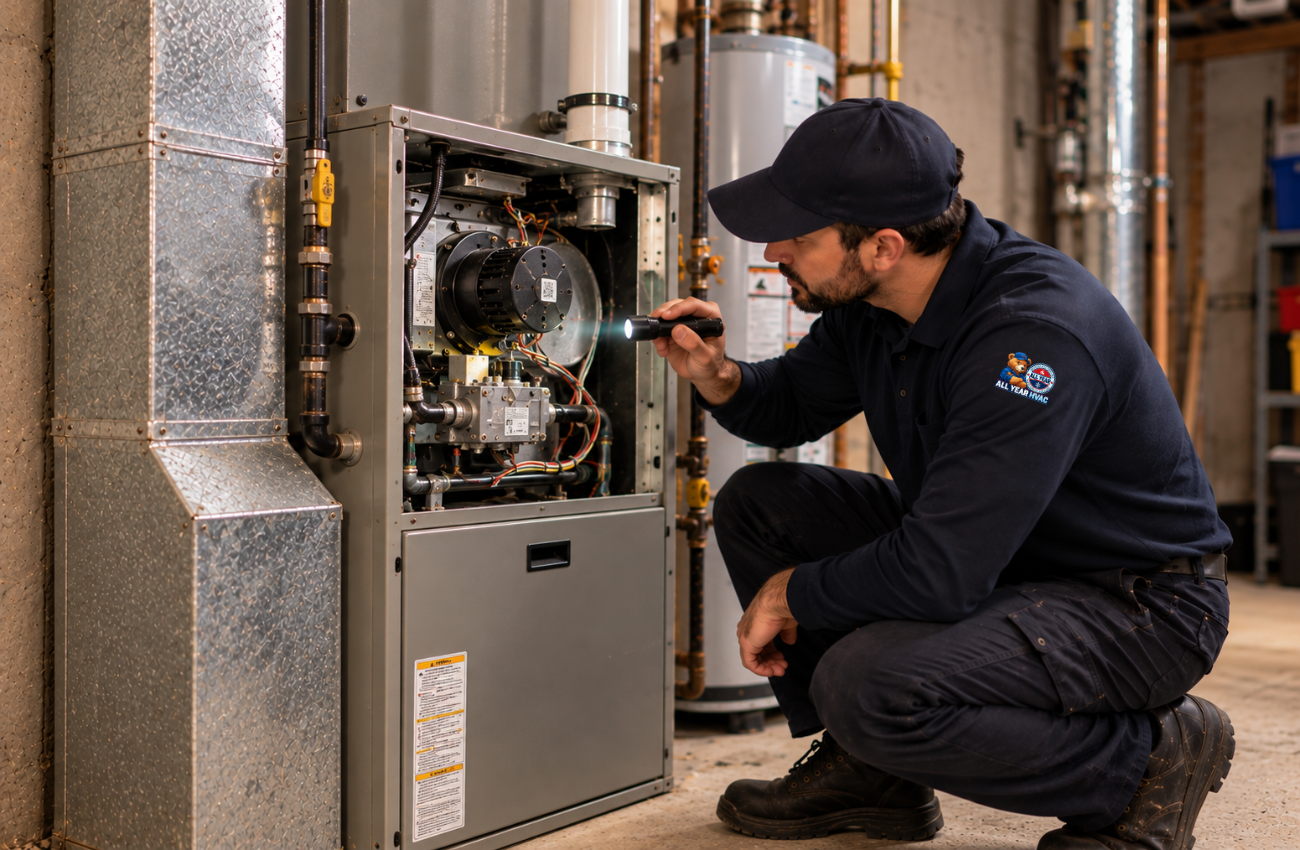
If you have an older furnace and are unsure about its condition, All Year Heating & Cooling can inspect the system and help identify any concerns.
If the furnace remains in reasonable condition and repair makes sense, you can make that decision with better information. If replacement is becoming worth considering, we can explain suitable options for your home and what would be involved in replacing the existing system.
We serve homeowners in Kitchener, Waterloo, Cambridge, Guelph and surrounding communities.
Financing Options for Furnace Replacement
Financing options are available for qualifying homeowners. Explore financing options or contact All Year Heating & Cooling to learn about current financing options and available promotions.