Choosing a heating system in Ontario is not always as simple as deciding between a heat pump vs gas furnace. Depending on the home, existing equipment and heating requirements, homeowners may have several options: a gas furnace, an all-electric heat pump system, or a hybrid system that combines a heat pump with a gas furnace.
For homeowners in Kitchener, Waterloo, Cambridge, Guelph and surrounding communities, understanding how these systems work together is especially important. Southern Ontario winters can include mild fall and spring weather as well as periods of much colder temperatures, and different heating systems handle those conditions differently.
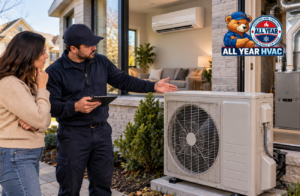
A heat pump can also provide both heating and cooling, which means it may replace the function of a traditional central air conditioner while adding the ability to heat the home.
So which configuration makes sense for your home? The answer depends on the existing HVAC system, heating load, electrical capacity, ductwork, equipment selection and how you want the system to operate throughout the year.
How Does a Heat Pump Work?
An air-source heat pump transfers heat rather than creating heat directly through combustion.
During the winter, the system extracts heat from the outdoor air and transfers it into the home. During the summer, the refrigeration cycle reverses and the heat pump removes heat from the home, operating much like a central air conditioner.
Natural Resources Canada explains that heat pumps can provide both heating and cooling, making them a year-round HVAC option rather than heating-only equipment.
Modern heat pumps can also use variable-capacity inverter technology, allowing the compressor to adjust its output as heating or cooling demand changes.
For a broader look at heat pump types, cold-climate technology, inverter systems and equipment options, see our Heat Pump Guide for Kitchener-Waterloo Homeowners.
However, the performance and heating capacity of an air-source heat pump can change as outdoor temperatures fall. This is one reason equipment selection, proper sizing and the choice of backup or supplemental heat are important in Ontario.
How Does a Gas Furnace Work?
A gas furnace produces heat by burning natural gas.
When the thermostat calls for heat, the furnace’s burners and heat exchanger generate heat, while the blower moves heated air through the home’s ductwork.
Unlike a heat pump, a gas furnace provides heating only. Homes with a gas furnace generally require a separate air conditioner or another cooling system for summer comfort.
Modern furnaces are available with different heating-stage and blower configurations. For example, single-stage, two-stage and modulating furnaces control heat output differently.
Gas furnaces can continue providing substantial heating output during very cold outdoor conditions, which is one reason they remain common in Ontario homes.
Heat Pump vs Gas Furnace: What Is the Main Difference?
The biggest difference is how the two systems provide heat.
A gas furnace creates heat through combustion.
A heat pump uses electricity to move heat from one location to another.
There is another major difference: a heat pump can provide both heating and cooling, while a furnace provides heating only.
That means the comparison is not always simply:
heat pump vs furnace
For many Ontario homes, the more useful question is:
Should the home use a heat pump with an air handler, a gas furnace with central air conditioning, or a heat pump combined with a gas furnace?
That third configuration is commonly called a hybrid or dual-fuel heating system.
What Is a Hybrid Heat Pump and Gas Furnace System?
A hybrid heating system combines an electric air-source heat pump with another heating source, such as a natural gas furnace.
Instead of forcing one piece of equipment to provide all of the home’s heating under every outdoor condition, the system can use different heating sources under different circumstances.
Natural Resources Canada describes hybrid systems as configurations where an air-source heat pump is paired with supplemental equipment such as a furnace or boiler. These systems can transition between the heat pump and supplemental heating based on factors such as outdoor conditions and system controls.
In a typical heat pump and gas furnace configuration, the heat pump can provide heating during appropriate outdoor conditions. When the controls determine that the alternate heat source should take over, the gas furnace provides the heating instead.
The exact changeover strategy depends on the equipment, system design, controls, outdoor temperature and other operating considerations.
Is Hybrid Heating the Same as Dual Fuel?
The terms hybrid heating and dual fuel are commonly used to describe systems that have two different energy sources available for heating.
For example:
- the heat pump uses electricity
- the furnace uses natural gas
The system therefore has two ways of heating the home.
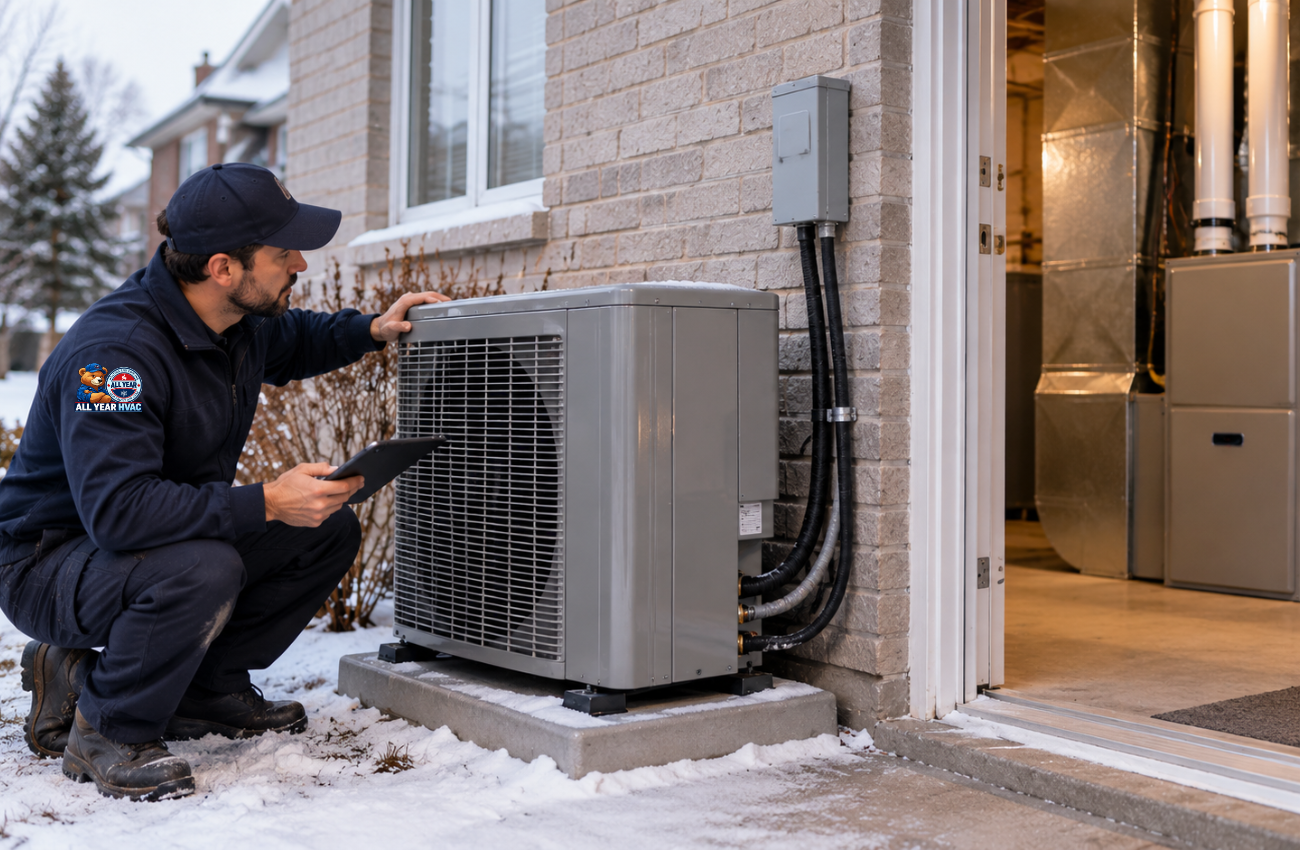
This configuration can be particularly relevant for homeowners who already have a forced-air gas furnace and central air conditioner. When the air conditioner eventually needs replacement, a compatible heat pump may be considered instead of installing another cooling-only outdoor unit.
This allows the heat pump to provide cooling in summer and heating during suitable conditions while retaining the gas furnace as the alternate heating source.
Does the Heat Pump and Gas Furnace Run at the Same Time?
In a typical dual-fuel configuration, the heat pump and gas furnace are not intended to heat the home simultaneously.
Instead, the controls determine which heating source should operate.
Natural Resources Canada describes hybrid systems as switching between heat-pump operation and the supplementary heating source rather than operating the two simultaneously.
The temperature or operating condition at which the system changes heating sources depends on how the equipment and controls are configured.
This is an important part of commissioning a hybrid system properly.
What About a Heat Pump With an Air Handler?
A heat pump does not have to be paired with a gas furnace.
An all-electric ducted system can use an outdoor heat pump connected to an indoor air handler.
The air handler contains the indoor coil and blower that move conditioned air through the home’s ductwork. The air handler itself should not automatically be thought of as the backup heat source.
Depending on the system design, electric resistance heating elements may be installed to provide supplemental or backup heating when required.
Natural Resources Canada identifies electric resistance elements in ductwork as one possible supplemental heating method for all-electric heat pump systems.
This creates an important distinction:
Heat pump + air handler = potentially an all-electric HVAC system.
Heat pump + gas furnace = hybrid or dual-fuel system using electricity and natural gas.
Both configurations can work, but they are designed and controlled differently.
Do Heat Pumps Work During Ontario Winters?
Yes, heat pumps can operate during Ontario winters, but not every heat pump has the same cold-weather capability.
Cold-climate air-source heat pumps are specifically designed to maintain operation at lower outdoor temperatures than conventional heat pumps.
Natural Resources Canada states that some cold-climate heat pumps are designed to operate at outdoor temperatures as low as approximately -30°C, although actual capacity and efficiency depend on the specific equipment and operating conditions. Natural Resources Canada
That does not mean every heat pump should automatically be expected to heat every Ontario home by itself at -30°C.
The home’s heating load, equipment capacity at low temperatures, duct system, electrical system and backup-heating strategy all matter.
We will cover cold-weather heat-pump performance in more detail in our upcoming guide to cold-climate heat pumps in Ontario.
Why Does Heat Pump Capacity Matter in Cold Weather?
A home’s heating demand generally increases as the outdoor temperature drops.
At the same time, the available heating capacity and efficiency of an air-source heat pump can change with outdoor temperature.
This relationship is important when designing a heat-pump system.
If the heat pump cannot provide the entire heating requirement under certain conditions, another heating source may be needed to provide the remaining load.
This is one reason homeowners should not select a heat pump based only on the nominal tonnage printed on the equipment.
The actual heating requirements of the home and the performance of the selected equipment at Ontario winter temperatures should be considered.
Does Proper HVAC Sizing Still Matter?
Absolutely.
Installing a larger heat pump or furnace does not automatically create a better heating system.
The home’s heating load can be affected by factors including:
- size and layout
- insulation levels
- windows and doors
- air leakage
- construction
- ductwork
- local design temperatures
If you want to understand why equipment sizing matters, our guide to proper furnace sizing for Ontario homes explains many of the same heating-load principles.
Natural Resources Canada also emphasizes proper selection, sizing and installation when choosing a heat pump. Natural Resources Canada
Can You Add a Heat Pump to an Existing Gas Furnace?
In some homes, yes.
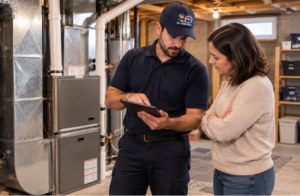
An existing forced-air furnace and duct system may be able to become part of a hybrid system when a compatible heat pump is installed.
However, compatibility should be evaluated before assuming that any outdoor heat pump can simply be connected to any existing furnace.
The contractor may need to consider:
- furnace and indoor coil compatibility
- available airflow
- ductwork
- heat-pump capacity
- electrical requirements
- thermostat and control compatibility
- refrigerant piping
- existing equipment condition
- available installation space
- manufacturer-approved equipment combinations
The condition and age of the existing furnace also matter. Pairing a new heat pump with a furnace that is already approaching replacement may lead to a different recommendation than working with a relatively new furnace in good condition.
If the existing furnace is becoming unreliable, our guide to furnace repair vs replacement explains some of the factors worth considering before investing further in the existing equipment.
Can a Heat Pump Replace Your Central Air Conditioner?
Yes. This is one of the most practical ways to think about a ducted heat pump.
A traditional central air conditioner provides cooling only.
A heat pump uses a similar refrigeration system but can reverse operation, allowing it to provide both cooling and heating.
For a homeowner who already has a gas furnace and needs to replace an aging central air conditioner, installing a compatible heat pump instead of another cooling-only unit may create the opportunity for a hybrid heating system.
ENERGY STAR specifically identifies this type of application as a potential dual-fuel configuration when a heat pump is paired with a gas or oil furnace. ENERGY STAR
Whether that upgrade makes sense depends on the equipment, installation requirements and homeowner’s goals.
Which Is More Efficient: a Heat Pump or Gas Furnace?
This comparison needs some context because heat pumps and furnaces measure efficiency differently.
A gas furnace converts fuel into heat. Its efficiency is commonly expressed using AFUE, which represents how much of the fuel’s energy is converted into useful heat over a heating season.
A heat pump transfers heat rather than creating all of its heat directly from electricity. Its heating performance therefore cannot be compared with furnace AFUE as though the two ratings mean the same thing.
Heat-pump efficiency and capacity also vary with outdoor conditions.
Natural Resources Canada describes air-source heat pumps as capable of delivering more heat energy than the electrical energy they consume because much of the heat is transferred from the outdoor environment rather than generated directly. Natural Resources Canada
However, higher equipment efficiency does not automatically mean lower utility bills in every home.
Electricity rates, natural gas rates, outdoor temperatures, system controls, building heat loss and equipment performance can all affect operating cost.
Is a Heat Pump Cheaper to Operate Than a Gas Furnace in Ontario?
There is no single answer that applies to every Ontario home.
Operating cost depends on:
- electricity pricing
- natural gas pricing
- outdoor temperature
- heat-pump efficiency
- heat-pump capacity
- furnace efficiency
- thermostat settings
- system changeover strategy
- the home’s heating load
NRCan research comparing cold-climate heat pumps and hybrid systems across Canadian home types found that the economics can vary depending on whether a home retains natural gas service and on regional energy prices. In some Ontario scenarios, hybrid configurations can be attractive when both gas and electricity remain available. Natural Resources Canada
For that reason, homeowners should be cautious with claims that one heating technology will always produce a specific percentage of utility savings.
The answer depends on the home and how the system is operated.
What Are the Advantages of a Heat Pump?
Depending on the home and system design, a heat pump can provide several benefits:
- heating and cooling from one system
- efficient heat transfer rather than direct resistance heating
- variable-capacity operation on many modern systems
- the ability to reduce reliance on fossil-fuel heating
- the option to create an all-electric or hybrid HVAC system
- year-round operation
For homeowners replacing an air conditioner, a heat pump may also provide heating capability that a conventional central AC cannot.
What Are the Advantages of a Gas Furnace?
A gas furnace may also have advantages depending on the home:
- strong heating output during very cold conditions
- familiar forced-air operation
- compatibility with many existing Ontario duct systems
- existing natural gas infrastructure in many homes
- the ability to serve as the alternate heating source in a hybrid system
The presence of a gas furnace does not necessarily mean a homeowner must choose between keeping the furnace and installing a heat pump.
In some cases, the two systems can be designed to work together.
What Are the Advantages of a Hybrid Heating System?
A properly designed hybrid system gives the home access to two heating sources.
The heat pump can provide heating and cooling, while the gas furnace remains available when the system switches to gas heating.
Potential advantages include:
- using a heat pump during appropriate heating conditions
- retaining gas heating capability
- replacing the function of a central air conditioner
- flexibility in how the home is heated
- less dependence on a single heating source
- the ability to configure system controls around equipment performance and operating conditions
However, adding more equipment capability also makes proper system design and control setup important.
A hybrid system should not simply be viewed as an outdoor heat pump attached to whatever furnace happens to be in the basement.
The equipment needs to work together as a system.
Heat Pump, Gas Furnace or Hybrid: Which Should You Choose?
There is no single configuration that is appropriate for every Ontario home.
A gas furnace may make sense when the homeowner wants conventional gas heating and a separate cooling system.
A heat pump with an air handler may make sense when the goal is an all-electric ducted heating and cooling system, with an appropriate supplemental-heating strategy where required.
A hybrid heat pump and gas furnace may make sense when the homeowner wants heat-pump heating and cooling while retaining a gas furnace as the alternate heat source.
The decision should consider the home’s existing equipment, heating load, electrical service, ductwork, fuel availability, installation requirements and homeowner priorities.
Hybrid Heating in Kitchener-Waterloo, Cambridge and Guelph
Homes throughout Kitchener, Waterloo, Cambridge, Guelph, Elmira, St. Jacobs, Elora, Fergus, New Hamburg, Baden, Ayr and surrounding communities can have very different heating systems and installation requirements.
Some homeowners already have a newer gas furnace but need to replace an older air conditioner. Others may be replacing both heating and cooling equipment at the same time. Some may be considering moving toward an all-electric system.
That is why the first step should be understanding the existing HVAC system and the home’s heating requirements before choosing equipment.
All Year Heating & Cooling can assess your existing furnace, air conditioner, ductwork and installation requirements and discuss whether a heat pump, conventional furnace system or hybrid configuration is appropriate for your home.
Contact All Year Heating & Cooling
Frequently Asked Questions
Can a heat pump completely replace a gas furnace in Ontario?
In some homes, a properly selected cold-climate heat pump can provide a large portion or potentially all of the home’s heating requirement. Other installations use supplemental electric heat or retain a furnace as an alternate heating source. The appropriate configuration depends on the home’s heating load, equipment performance and system design.
What is a dual-fuel heat pump system?
A dual-fuel system combines an electric heat pump with another fuel-based heating source, commonly a natural gas furnace. The system can switch between the heat pump and furnace based on its controls and operating conditions.
Can I keep my gas furnace and add a heat pump?
Potentially. A compatible heat pump may be paired with an existing gas furnace to create a hybrid system. The furnace, indoor coil, blower airflow, controls, ductwork and other components should be evaluated for compatibility before selecting equipment.
Does a heat pump also provide air conditioning?
Yes. An air-source heat pump can operate in reverse during warm weather and provide cooling similar to a central air-conditioning system.
Does a heat pump work below freezing?
Yes. Modern heat pumps can operate below freezing, and cold-climate models are specifically designed for lower outdoor temperatures. However, heating capacity and efficiency vary by model and temperature, so equipment selection and backup-heating strategy remain important.
Do the heat pump and gas furnace run together in a hybrid system?
Typically, a dual-fuel system switches between the heat pump and gas furnace rather than using both as heating sources simultaneously. The exact control strategy depends on the equipment and system configuration.
Is hybrid heating a good option for Kitchener-Waterloo?
Hybrid heating is one configuration that can be considered for homes in Kitchener-Waterloo, particularly where a homeowner wants heat-pump heating and cooling while retaining a gas furnace. Whether it is appropriate for a particular home depends on the existing HVAC equipment, heating load, electrical capacity, ductwork and installation requirements.